Nitrogen (N2) and oxygen (O2), the main components of air, are preferable feedstocks for the synthesis of high-value nitroaromatic compounds used in pharmaceuticals and agrochemicals. Current industrial routes rely on multi-step, energy-intensive processes under harsh conditions. Direct one-step synthesis of nitroaromatic C–N–O compounds from air under mild conditions is highly desirable as a potential more sustainable production route. However, activating inert N2 typically requires harsh conditions that may lead to excessive activation of O2 and oxidation of the aromatic substrate, reducing product selectivity. The key challenge lies in achieving controllable activation of reactants and selective C–N and N–O coupling while avoiding over-oxidation.
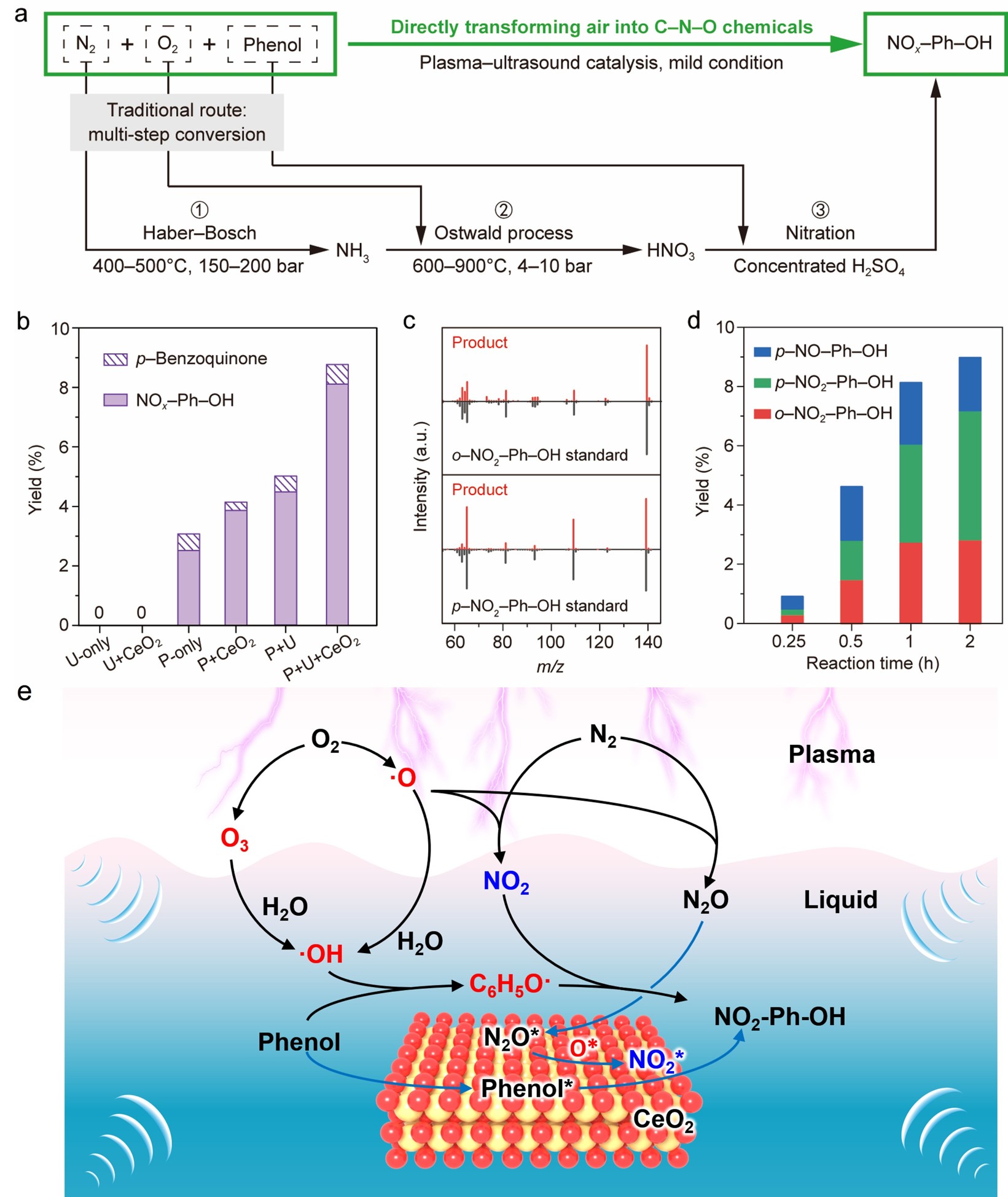
Schematic illustration and the performance for direct conversion of air and phenol to C–N–O chemicals by plasma-ultrasound catalysis (Image by LI Di)
In a study published in National Science Review, a research group led by Profs. DENG Dehui and YU Liang from the Dalian Institute of Chemical Physics (DICP) of the Chinese Academy of Sciences (CAS) developed a plasma-ultrasound catalytic (PUC) process. The process employs CeO2 as catalyst in a home-made plasma-ultrasound synergistic reactor, enabling the co-conversion of air and phenol into valuable nitroaromatic compounds under mild conditions. At 5 °C and atmospheric pressure, the process achieved an overall yield of 8.1% with 92.5% selectivity for nitroaromatic chemicals (nitrophenol and nitrosophenol) within one hour.
Moreover, the researchers elucidated that air plasma produces reactive oxygen species and NOx, which oxidize phenol to phenoxy radicals (C6H5O·), followed by their conversion into nitroaromatic products. The coupling of ultrasound and CeO2 catalyst enables a heterogeneous catalytic pathway that promotes formation of NO and NO2 from N2/N2O and subsequent nitration via the enhancement on mass transfer and reaction kinetics by ultrasonic cavitation effect. This plasma–ultrasound process separates the activation of air from that of phenol, suppressing excessive activation and overoxidation.
“Our study establishes a new PUC process for efficient and selective synthesis of valuable C–N–O chemicals directly from air and carbon substrates under mild conditions,” said Prof. DENG.
Link:
https://dicp.cas.cn/xwdt/kyjz/202610/t20261021_8296552.html
https://doi.org/10.1093/nsr/nwag556