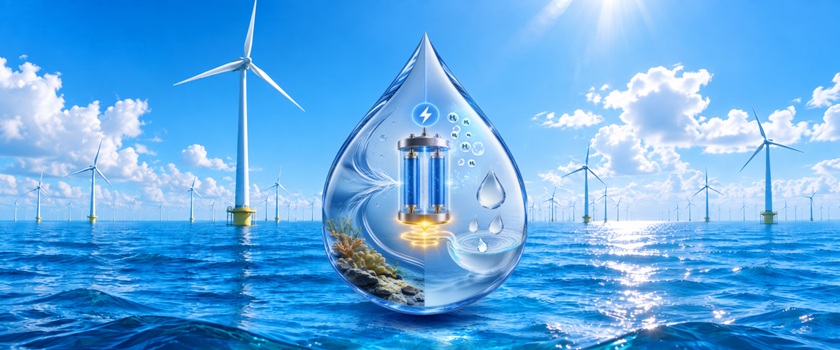
Hydrogen production from seawater via water electrolysis using renewable energy is considered a desirable and sustainable pathway for mass production of hydrogen.
However, the practical viability of direct seawater electrolysis is severely limited by poor stability caused by electrode side reactions and corrosion issues arising from the complex composition of seawater. A potential alternative is to desalinate seawater into freshwater prior to electrolysis. Yet this tandem process involves a seawater desalination unit and requires additional energy input, thereby making it less economical. Additionally, water electrolysis exhibits relatively low electricity-to-hydrogen efficiency, usually less than 70%, with unused electrical energy ultimately converted into low-grade waste heat, leading to significant energy loss. Therefore, it is urgent to develop a low-energy-consumption, highly efficient, and robust process for mass production of hydrogen from seawater.
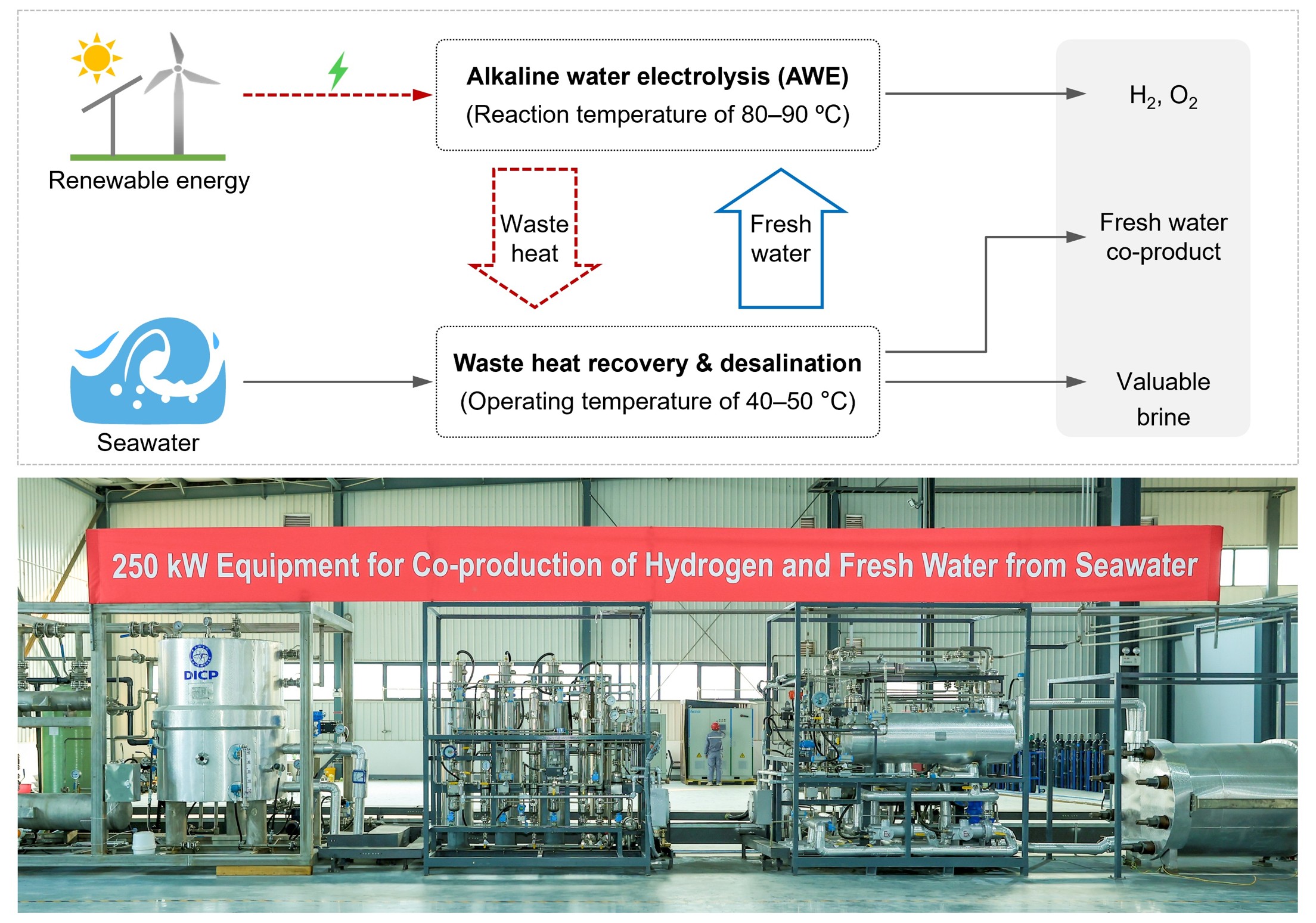
A 250 kW system and its process for co-production of hydrogen and fresh water from seawater (Image by JIANG Shang)
In a study published in the Nature Energy, a team led by Prof. DENG Dehui and Associate Prof. LIU Yanting from the Dalian Institute of Chemical Physics (DICP) of the Chinese Academy of Sciences (CAS) proposed a “seawater to hydrogen and fresh water (STHW)” route that couples AWE with low-temperature vacuum distillation desalination. The STHW process utilizes waste heat from AWE for low-temperature desalination, generating fresh water for both electrolysis and external use, while the resulting valuable brine enables resource recovery of components such as salt, uranium, and bromine.
The team built a 20 kW industrial pilot STHW system with a hydrogen productivity of 3.8 Nm3 h-1, which can operate stably for 100 days while co-producing 1.2 kg h-1 of fresh water. When scaled up to 250 kW, the system achieved a productivity of 48 Nm3 h-1 for H2 with a purity of 99.9999% and 31.6 kg h-1 for fresh water, alongside a 14.4% improvement in system electrical efficiency compared to conventional alkaline electrolysis of fresh water alone.
“This study overcomes the dual bottlenecks of low-grade waste heat utilization in water electrolysis and the poor stability and low energy efficiency of hydrogen production from seawater, which will promote the scalable and high-quality development of the marine economy and green hydrogen,” said Prof. DENG.
This work was highlighted in a News & Views article in Nature Energy. Prof. Jonathan G. Love from Central Queensland University appraised it as an important and interesting work, which overcomes community concerns about fresh water while reducing hydrogen production costs.
Key words: Seawater-to-hydrogen, alkaline water electrolysis, seawater desalination, coupled system
Link:
https://dicp.cas.cn/xwdt/ttxw/202609/t20260916_8283551.html
https://doi.org/10.1038/s41560-026-02130-6