Proton exchange membrane (PEM) water electrolysis represents an ideal pathway for green hydrogen production from renewable energy, yet its large-scale deployment is hindered by the reliance on precious platinum-based catalysts. MoS2 has emerged as a promising non-precious electrocatalyst owing to its low cost, but its hydrogen evolution reaction (HER) performance is limited by the scarcity of active sites confined to S-edges and the inherent inertness of the basal plane. Although strategies such as size reduction to expose more edge sites or metal doping to activate in-plane sulfur atoms have been widely explored, the former suffers from high surface energy and poor structural stability, while the latter often induces excessively strong hydrogen adsorption on edge S sites that compromises catalytic activity. Hence, simultaneously achieving the exposure and stabilization of MoS2 edges while enhancing the HER activity of both basal plane and edge sites remains a critical challenge in this field.
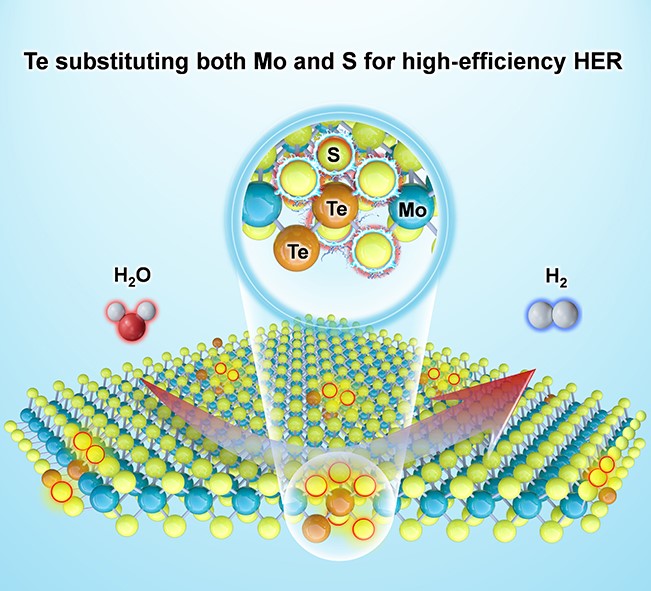
Schematic illustration of Te substituting both Mo and S for high-efficiency HER
In a study published in the Angewandte Chemie International Edition, a team led by Prof. DENG Dehui, Prof. CUI Xiaoju, and Prof. YU Liang from the Dalian Institute of Chemical Physics (DICP) of the Chinese Academy of Sciences (CAS) has report a dual-site substitution of both Mo and S with tellurium in the MoS2 lattice (Te-MoS2) to yield large-current-density HER performance in acidic electrolyte, surpassing all previously reported single element-doped MoS2 with nonmetal or non-precious metal.
The researchers demonstrated that the Te-MoS2 catalyst requires an overpotential of only 364 mV to achieve an industrial-level current density of 1000 mA·cm-2, significantly lower than 662 mV required by commercial 20 wt% Pt/C, and that it maintains this performance stably for 200 hours without decay. Comprehensive analyses reveals that the simultaneous substitution of Mo and S with Te atoms activates neighboring S atoms and also promotes the formation of smaller, edge-rich MoS2 nanosheets, thereby generating abundant basal plane and edge S active sites with optimized hydrogen adsorption energy.
“This work proposes the concept of single-element dual-site substitution, offering a valuable strategy for designing highly efficient MoS2-based catalysts for hydrogen evolution”, said by Prof. DENG.
Link:
https://dicp.cas.cn/xwdt/kyjz/202607/t20260710_8245431.html
https://onlinelibrary.wiley.com/doi/10.1002/anie.4057686