Cyanohydrins are valuable chemical intermediates used in the production of antidepressants, antiviral drugs, and synthetic plastics. Their conventional synthesis relies on multi-step process involving energy-intensive production of ammonia and hydrogen cyanide, resulting in high energy consumption, high carbon emissions and safety concerns associated with toxic reagents. Developing a direct route to cyanohydrins from abundant feedstock such as nitrogen and methane under mild conditions has long been a major challenge.
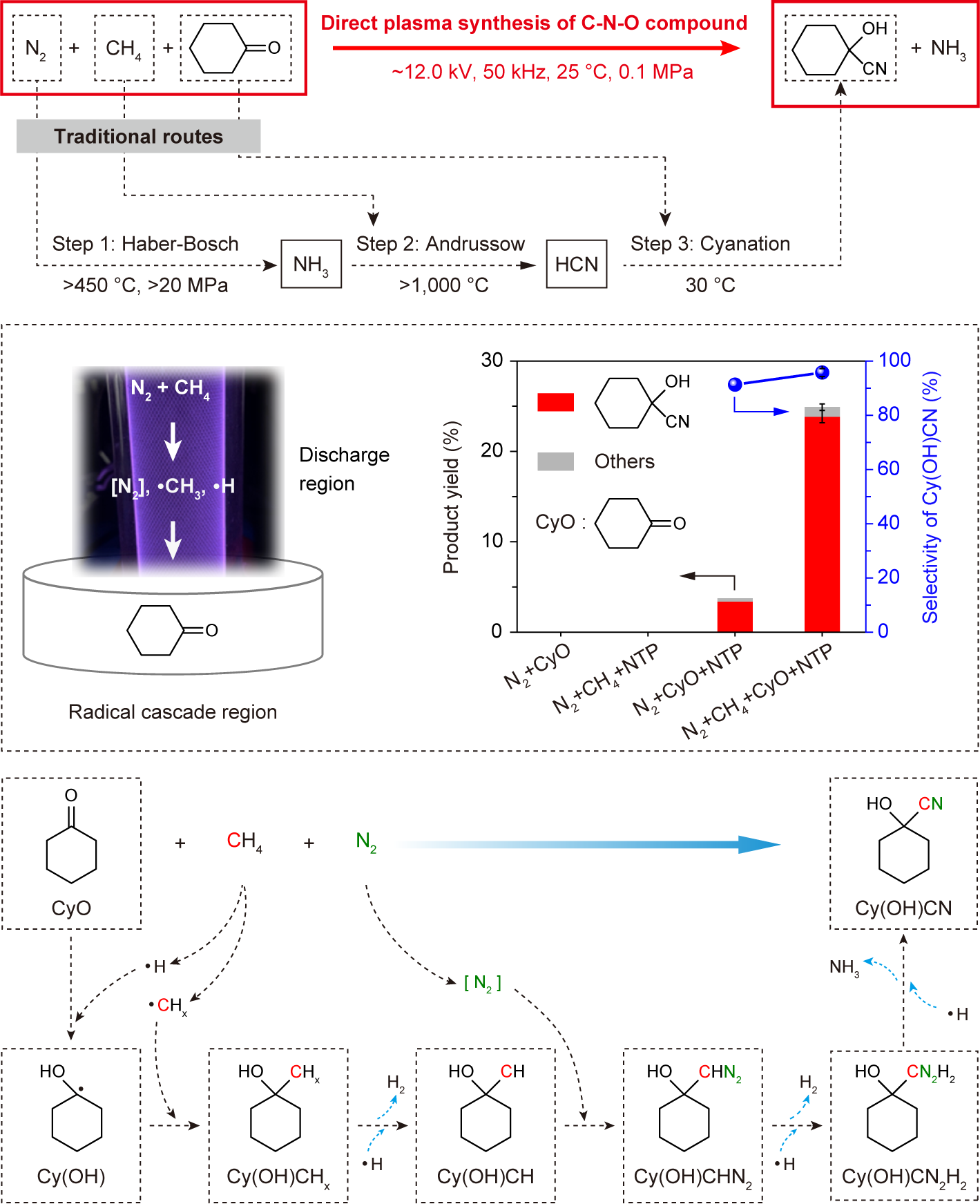
Schematic illustration of the performance and radical relay mechanism for the reaction of cyclohexanone and non-thermal plasma (NTP)-activated nitrogen and methane (Image by ZHANG Hao)
In a study published in Nature Synthesis, a research group led by Profs. DENG Dehui, YU Liang, and HUANG Rui from the Dalian Institute of Chemical Physics (DICP) of the Chinese Academy of Sciences (CAS) developed a plasma-cascade process that enables the direct synthesis of cyclohexanone cyanohydrin [Cy(OH)CN] with nitrogen, methane, and cyclohexanone under mild conditions. The process achieved a Cy(OH)CN selectivity of 95.8% selectivity, a yield of 23.9%, and a formation rate of 0.60 mmol h-1.
The researchers proposed a plasma-driven radical cascade mechanism for the reaction. Under non-thermal plasma, nitrogen and methane are excited to generate reactive species, including excited-state nitrogen as well as ●CH3 and ●H radicals, which subsequently react with cyclohexanone.
Researchers revealed that plasma-generated ●H radicals first activate the C=O bond of cyclohexanone to form hydroxy-cyclohexyl intermediates, which subsequently undergo C-C coupling with ●CH3 redicals. The resulting α-CHx cyclohexanol species further reacts with excited-state nitrogen to form a C-N bond. Assisted by ●H radicals, the N≡N bond is subsequently cleaved, ultimately yielding the target product cyclohexanone cyanohydrin along with high-value ammonia as a co-product.
“Our study establishes a new green reaction pathway for the direct one-step synthesis of cyanohydrins from nitrogen and methane with high selectivity, offering a new strategy for the direct and efficient utilization of inert small molecules under mild conditions,” said Prof. DENG.
Link: https://www.dicp.ac.cn/xwdt/ttxw/202606/t20260610_8227115.html